
When I received Filippo’s initial proposal outlining his idea to follow his residency in South Africa with an ‘encore’ programme that would take myself and one other student to Europe for a couple months – I was of course excited, and I felt (not for the first time) a little bit in awe of this man who quite abruptly appeared in my life last year with an appetite for giving I have seldom seen matched. However, I truly underestimated what this trip would ultimately mean to me.
Classical music is hardly new in South Africa. I study piano at the college of music in Cape Town, which has existed since 1910. The Cape Town Philharmonic Orchestra has existed since 1914. However, with the notable exceptions of this orchestra, and of the annual Stellenbosch Chamber Music Festival, both of which regularly attract a handful of international artists to South African stages, the classical music community here on the tip of Africa, while vibrant, is relatively insular. I knew immediately that the opportunity to get lessons from, build connections with, and hear a wide array of musicians from the melting pot that is the European classical music scene would be an invaluable one; I didn’t realise it would be literally ‘life-changing.’ It is early days yet but everything is so different for me now, so I’m pretty confident that’s not an exaggeration.
It is no small challenge to sum up the overwhelming variety of experience that constitutes a two-month stint absorbing musical life in four of the great European capitals. The great strength of language is that it narrows the aperture of our attention, focussing it onto a single idea, much like a magnifying glass channels the rays of the sun. The real value gleaned from such a trip arrives, however, as a series of creeping impressions, sensations, things felt before they are known. Single words – the names of places and peoples and foods and famous performers and concert halls – once abstract concepts, now enter my perception only to be instantly refracted into an array of colour by the prism of my travel experience.
Wherever we went, music students showed interest in us and helped us where they could. Filippo’s musician friends – the Italian diaspora in particular – were invaluable, giving up their time and their space to support our trip. I think the Italians are the South Africans of Europe. They are friendly, direct, impossible to offend, love good food, come from a beautiful, sunny bit of the world, and have a fantastic sense of humour – a real appreciation of the ridiculous. I got along well with every Italian I met.
A group of people I didn’t actually come into contact with but owe a lot to nonetheless were the myriad of presenters Filippo tirelessly bombarded with emails to procure discounted or complimentary tickets to concerts at top venues for Dané and I. In London, we were privileged to see Rigoletto at the Royal Opera. A raw and challenging performance – old art, boldly and freshly presented in a manner that required the audience to reflect on uncomfortable, unchanging truths about the human condition.
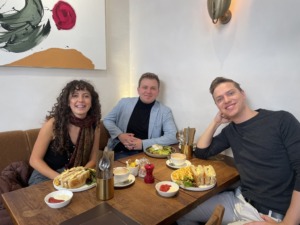
We also heard a number of performances at Wigmore Hall, the most compelling of which was Filippo’s own solo recital. In particular, the total excitement of his opening piece – a recent etude by Beat Furrer – and the serenity of his Beethoven op. 110 remains vivid in my mind’s eye. One of Filippo’s Italian friends, Leonardo, remarked to me how it has always been a little surreal to watch Filippo transform “into an old man” onstage. There is certainly a prophetic aspect to his playing. Filippo models particularly clearly the total commitment to the lifelong process of self-sacrifice in search of the Mystery we love that marks a musician of great spirit.
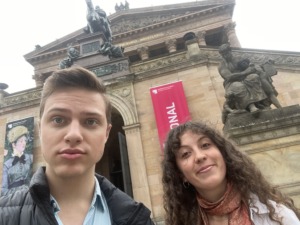
In Berlin we were left quite speechless (and those who know me will know that I am seldom without speech) by a performance of the Berlin Philharmonic under the baton of Kirill Petrenko. Gautier Capuçon’s Rococo variations were exquisite, and his encore, Song of the Birds accompanied by the Berlin Phil celli, was punctuated by silences of a gravity I had never heard before. Breaths, great inhalations, not of a person but of some organism far older and wiser. A simple piece, only a few phrases long, but played that evening in a way that showed it contained lifetimes. In the second half, Beethoven 2nd with a passion, fidelity, and majesty that once again, I had never heard before. The sort of playing that breeds the bittersweet realisation that the only limitation to the depth of the experience is one’s own focus.
Our good friend violinist Miclen LaiPang, who regularly plays in South Africa, happened to be playing in Currentzis’ Utopia in Berlin during our time there, and generously augmented the eye-watering itinerary of concerts Filippo had arranged with a couple tickets to hear Utopia’s Mahler 1 at the Funkhaus. I did not know a string section could sound like that, and like so many different things. Some of the climaxes were literally terrifying – that is, they activated the fight-or-flight response. The performance had an unbelievably total energy and unity – a specificity and flexibility of gesture so intimately personal it felt impossible. With Currentzis at the helm, the orchestra achieved expressive nuances of such complexity, conviction, and clarity, one would assume they are only possible from a great great pianist or fantastic small chamber group – not a hundred different people.
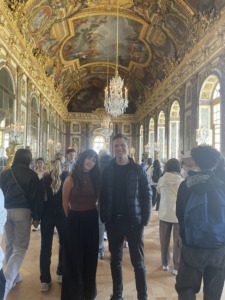
In Paris, we heard Ivo Pogorelić play an all-Chopin programme at the Philharmonie. He played from sheet music and was clearly reading at certain points – visibly looking for things and distorting time in order to get to them during the harmonically dense bits of the Barcarolle and first and second movements of the 2nd Sonata. What I don’t mean to say is that it was at all a bad performance. It was unforgettably honest. A golden tone. The most intimate pianissimos. Exquisitely subtle chamber music sounds in the Second Concerto. A left hand unafraid to often be – shock and horror – far more prominent than the right, and at moments when the right has the melody, no less. A unique sense of line, constantly teetering on the edge of verticality, but somehow, as if by miracle, inexorably falling forwards until the last note, producing a little bit of that old sense of organic unity of structure, that grand style of playing that embraces pieces whole, that larger, nobler conception that frees the performer, foregrounding the things that matter – direction, narrative, architecture, sound, spirit – and backgrounding the precise expression of the present moment, such that small ‘imperfections’ are forgiven and a larger truth beheld. Not just poetry, but story, oratory, chronicle.
The thing we make as pianists is not (or at any rate, shouldn’t be) a sound – it is a feeling, and equally, the instrument we play is not the piano – it is the hearts of the people in the audience. To play for others is to do nothing short of painting on the canvas of the human soul, a medium that records not sounds but the hopes, laughter, loves, fears, and scars of human experience. Pogorelić understands.
In Vienna, we heard many incredible concerts, presented by world famous soloists, conductors, and orchestras on some of the most prestigious stages in classical music. Hayato Sumino’s Ravel Concerto in G major with the Vienna Phil under the baton of Popelka in the Konzerthaus. We heard the same orchestra play the final trilogy of Haydn Symphonies under the direction of Muti in the Musikverein. This in addition to solo recitals given by Seon-Jin Cho and Bruce Liu, as well as Thomas Adès conducting works by Ives, Kurtág, Adès, and Tchaikovsky, and even a smattering of chamber music.
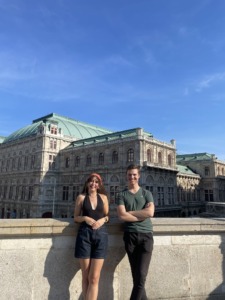
To say we witnessed fantastic music-making in Vienna would be a criminal understatement. However, what impressed me the most during my time there was, strangely, not the concerts so much as the humanity of the man we stayed with – Ivo, a conservator, who shared freely not just of his apartment near the city centre but of his experiences growing up in Germany after the second world war. Prof. Dr. Ivo Hammer-Tugendhat was born in Ulm in 1944 during a bombing raid that destroyed his parent’s house. He explained that they never had enough food growing up, so they had music instead. He played the violin, and his mother the piano. He spoke about playing Bach with her growing up, about playing Mozart with her shortly before she passed. He spoke about his father, who survived the Eastern front but carried the incomprehensible horror of it home to his family. He spoke about history, and trauma, and he spoke about reconciliation in a way I’ll never forget. “Forgiveness? Who can forgive the Holocaust. Even if I was in the camps, it would not be for me to forgive. Reconciliation is about looking things, and people, in the eye.” I suppose this is why, when Apartheid ended in South Africa, we had a Truth and Reconciliation Commission, not a Sorry and Reconciliation Commission.
Ivo is one of the most intensely human souls I have ever met, and it is impossible for me to adequately convey the worth of knowing him the handful of days I did. Ivo cried every time I played for him. He knew the worth of music and had a connection with it most musicians can only dream of.
What, then, is it that changed for me during my time in these four cities? I certainly didn’t get better at the piano – not instantly. When one is tired, disorientated, and doesn’t constantly have access to a piano, the fingers get a little sluggish. I played a few truly awful lessons (sorry Mr. Beisembayev, Prof. Sticken, and Prof. Wollenweber – you were all very patient). Some of the lessons I had were definitely special, but no-one had a ‘golden bullet’ that would fix me (and there is maybe a tendency amongst students in South Africa to think that such a bullet might exist, and that teachers in London or Paris or Vienna or Berlin, where the grass is greener, might be armed with them).
It was also interesting to note that while the standard of playing we heard in concerts was, overall, higher than it is back here in South Africa, the ‘magic’ – that certain something that demands total attention, that grabs you by the ear and drags you along from start to finish – occurs about the same percentage of the time in Europe as it does in South Africa. There is a certain democracy to that, I suppose. As Filippo puts it, we practise and practise and work and work to make sure the conditions are as conducive as possible to the occurrence of this ‘Thing’, but on the day it is not up to us whether It graces us with Its presence. This is good: if we were totally in control it wouldn’t be art. The product (insofar as one can say there is one) is a process. In this sense, classical music is quite countercultural today.
I won’t try to say yet what has changed in me. I don’t want to belittle it. What I do know is that since I have returned, I have been practising more, and with more focus, consistency, enjoyment, and freedom than I have in my life, such that I have learned more over the last month of practise and performance than I have over the last year, I have given four of my best recitals yet to some vocally appreciative audiences, and I am deeply excited to see where this new something I am experiencing takes me a year, a couple years, a decade from now.
I want to finish by talking a bit about cathedrals. The cathedrals were, for me, a common thread in each city, oases of peace, beauty, and stillness – silent reminders of what the modern world would have us forget. City centres in European capitals can be exhaustingly busy places, teeming with a bamboozling amount of human activity. After a while in such a sensorily overwhelming environment everything seems to blend together and one can struggle to discern even one’s own thoughts through the TV static in one’s mind. That is, until you walk into a cathedral, and a calm falls upon the heart.
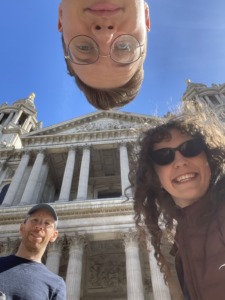
To be certain, each city centre has its own personality and appeal, is worthwhile in its own way, and boasts incredible sights, institutions, and feats of engineering and convenience. Equally, however, these city centres are locations that – for better or for worse – have been gradually shaped over the last few centuries by that particular creeping, inexorable force, that winning ideology, the idolisation of commerce. The heart of each city bears the marks of a frenzied way of being that we may one day, living in the ashes of the world it built and destroyed, describe as ‘late capitalism’ – the rampant consumerism which, completely divorced from any compassionate set of priorities, ultimately took so much from us. These marks take a myriad of forms: the anti-homeless architecture, the concrete eyesores, the tourist traps, the liminal spaces filled with nameless trash, the anonymous glass rectangles we aggrandisingly call skyscrapers, the garish logos of fast-food chains staffed by minorities, the plastic, the stress, the hurry, the homeless people no-one sees, the mass-produced background music no-one listens to, the responsibilities no-one wants, the occasional, deeply distressing absence of any living thing other than the seething, prolific cancer of humanity, and the sight of person after person after person experiencing or distracting themself from or misrepresenting reality through the lens of their phone.
I don’t mean to write a sermon condemning the ‘force’ I am describing – in a sense, there is nothing special about it, it is merely a strong candidate for the dominant shape our selfishness has taken over the last few centuries. However, that these cities are the capitals of great developed nations is telling – their centres must, in some sense, tell us what we are, what we value, what we are building.
And so, the cathedrals are precious. These cathedrals have preserved not just the silence and the beauty but something of the spirit of a lost age. Far from being merely pretty, they speak of a time in which men spent their lives building things that would only be enjoyed by their great grandchildren, when we searched for and feared something beyond ourselves, when we knew the meaning of sacrifice, when the idea that it is best to minimise input and maximise output had no place in the arts. A time before modern individualism, when we respected the fact that our identity and value lie, to a large extent, outside of ourselves. Not a perfect time, but a time we can learn a lot from nonetheless.
I am reminded that every time I practise my instrument, there is a sense in which I am building a cathedral. We must never stop building cathedrals.
Read Dané van Graan’s Encores from 7 Cities blog Getting to Know Me here
Photographs by Isaac van der Merwe