
Filippo Gorini’s Encores from 7 Cities and Sonata for 7 Cities were both pivotal events for me and among the greatest gifts I have ever received. I am so incredibly grateful and excited for this opportunity – to simply learn, discover and grow, to bring myself as I am, meet new people, make new friends, broaden my horizons, and deepen my relationship with music and the piano.
LONDON
Highlights: Verdi’s Rigoletto, Filippo’s recital at Wigmore Hall, Liederabend at Wigmore Hall, a ridiculous amount of tea.
Lessons: Becoming a better musician is fully intertwined with becoming more fully yourself.
Arriving in London, I felt like the happiest person on the planet. I vaguely remember thinking that I was going to wake up and discover it had all been a dream, that London would simply disappear. It was surreal to finally be there!
It was a great joy to reunite with Filippo for the first time since September. Somewhere between Isaac’s and my first bowl of ramen and a rather unforgettable stolen backpack containing some very important contemporary scores for Filippo’s upcoming Wigmore Hall recital, there was a memorable conversation that really resonated with me.
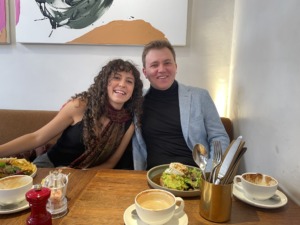
We spoke about the importance of spending time with yourself, looking inward and getting to know yourself on a deep, emotional and honest level. When you understand what makes you you, when you become familiar with your own soul, you begin to bloom from the inside out. In doing so, you also become better able to recognise what makes other people who they are, allowing for deeper and more genuine human connection.
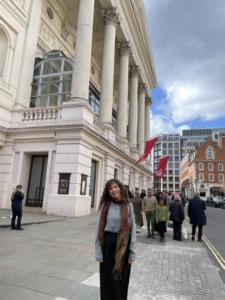
It made me wonder whether this is something we as musicians should think about more often. You can strive to be technically brilliant, polished or even ‘perfect’, but are you staying true to who you are? Are you connected to your own sense of self? Are you sharing something that is genuinely important to you? Perhaps it is through that authenticity that we can connect most deeply with those who listen.
London is an exceptionally busy city, filled with people constantly on the move. Yet somehow, in contrast to that energy, I also found an unexpected sense of peace. There seemed to be space for introspection, whether sitting quietly on a train, wandering through one of the city’s many parks, reflecting on all the different art, walking its streets or reconnecting with old friends.
One afternoon, while we were sitting in Kensington Library, Viv, a dear friend of mine, looked at me and said, “I’m excited to see who you’ll be by the end of this trip.” It made me realise that I too was excited. Not only to discover new cities, but also to discover what each one would teach me about myself and about music, because every place has something to teach us if we are willing to listen.
As I reflected on my first two weeks while sitting amongst the beautiful flowers in Kew Gardens, it became clear that although this journey was centred around learning more about Europe, its culture, history and music scene, as well as potentially opening doors for future study and career opportunities, it had already become so much more than that.
The more I travelled, the more I realised that music is inseparable from the person performing it. We do not simply share what was written, we share part of ourselves. Perhaps discovering yourself as a person is just as important as developing yourself as a musician.
PARIS
Highlights: Prokofiev’s Romeo and Juliet ballet, Ivo Pogorelić at the Philharmonie, visiting Versailles, the Louvre and Notre Dame, special interactions with new friends.
Lessons: The difference between knowing and experiencing.
The two weeks in Paris flew by and all I can say is we certainly got the full Parisian experience! My first thoughts upon arriving were, “There’s not enough grass… and I don’t speak French!” Yet despite my initial apprehension, it didn’t take long to fall in love with the city. Paris is stunning and iconic, a special place where everything somehow seems picture-perfect. Our late-night drive through the city to our apartment already started out feeling quite magical. Catching my first glimpse of the Eiffel Tower through the car window had me bubbling with excitement for the weeks ahead.
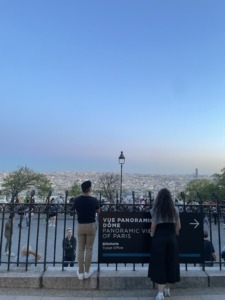
Sitting beneath the Eiffel Tower one evening with a dear friend I had met only a year earlier, sharing a baguette, brie and a bottle of wine, I remember thinking how incredible life is. How every person we meet and every seemingly insignificant moment contributes to a much bigger picture.
I was very surprised by how easy practising became in Paris and all the cities that followed. Whenever we had access to a piano, finding inspiration or motivation never felt like something I had to search for. It simply existed in my surroundings.
During this visit, someone shared Walt Whitman’s poem “When I Heard the Learn’d Astronomer.” It got me thinking about my tendency to intellectualise and understand things, something I often put pressure on myself to be better at, especially when it comes to understanding music. Yet this was a reminder that to fully understand something, whether nature, life or beauty, it also needs to be experienced.
That idea stayed with me throughout my time in Paris and was followed by Pogorelich’s recital at the Philharmonie, which I found so moving and captivating. He took us on a journey and carried us through every note.
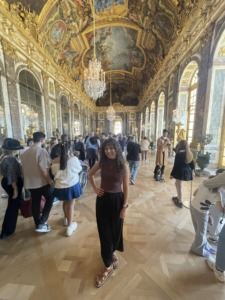
Another big moment was attending my very first live ballet. I was completely immersed from beginning to end. Aside from the beauty, grace and the ability of the dancers to take you on a journey through movement alone, what moved me most was the ending. After so much conflict and hatred, it was grief that finally brought the two families together. There was something profoundly human about seeing them united, if only in their shared sorrow. It was both heartbreaking and breathtaking.
Paris is a city filled with hidden gems: cafés, beautiful streets, lively nightlife… and if ever there was a place made to romanticise your everyday life, it’s probably Paris. More than anything, the city reminded me that not everything worth knowing can be learned from a book or taught in a lesson. Some lessons can only be understood by being present enough to experience them. While I learnt an incredible amount in every lesson during the two months, I learnt even more in concert halls, connecting with art, exploring history museums and simply observing the world around me.
BERLIN AND HAMBURG
Highlights: Berlin Philharmonic, Mitsuko Uchida at the Boulez Saal, Steinway Factory in Hamburg.
Lessons: One of the greatest limitations we face is the one created by our own perception of what is possible.
Berlin was not necessarily the most beautiful city we visited, nor was it my favourite, but being kindly helped by a stranger on our very first day and getting to know him in the process was the first of many meaningful interactions we had during our time there. Somehow, every conversation seemed to leave me with something to think about.
One of my favourite things about the city was the many flower shops scattered throughout it. They felt like a small reminder that it really is the little things that matter; a bunch of flowers, a few kind words, a helping hand from a stranger, or a brief interaction with someone you may never see again. Sometimes, the smallest acts of kindness and the most fleeting encounters can leave the biggest impression.
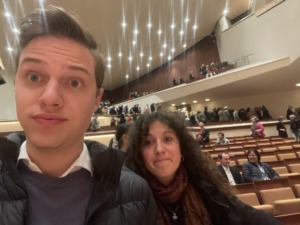
There were also plenty of musical highlights in Berlin; hearing the Berlin Philharmonic live was an absolute dream come true and left us both in silence after the concert. Then there was Mitsuko Uchida, someone whose recordings I’ve grown up listening to, in the flesh at the Boulez Saal. Both were absolutely unforgettable.
One of the greatest experiences of the entire trip was a brief visit to Hamburg where we visited the Steinway Factory. Learning about Steinway’s history and philosophy before being taken through every stage of the piano-building process gave me an entirely new appreciation for the instrument itself. Stacks of wood gradually became works of art in the making. I was in awe of the craftsmanship, the patience and the extraordinary attention to detail that goes into every single instrument. There is no “cookie-cutter” approach. Every piece of wood is carefully selected, every piano develops its own character, and every instrument is built with remarkable care.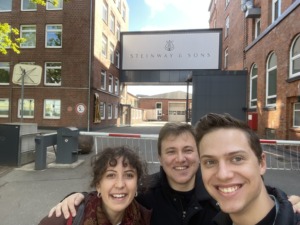
We ended our visit in the selection rooms, a place I’d heard about many times but never imagined I would have the privilege of experiencing this early in my life. I knew the stories of pianists trying dozens of instruments until they found the one they connected with and how remarkable that could be. By this point in the trip, something that had come up for me very often, particularly in lessons, was this idea of letting go. As I played the opening of the second Chopin Ballade on one of the pianos, for the first time it made sense to me. I wasn’t thinking about controlling every movement or trying to make something happen. I simply felt connected: to the instrument, to the music and to the present moment. There was no trace of the frustration and doubt I often carry with myself as a pianist. I felt capable. I felt free.
Over the past few years, I have, as many do, faced my own challenges with performance anxiety – everyday anxiety, fear of failure and the constant feeling of not being good enough. One of the biggest personal battles has been learning to perform without beta blockers after relying on them for almost nine years. There was so much pressure that I put on myself to be something, to prove something, that I often lost sight of what was important. Before this trip, I had already made significant progress in overcoming many of these challenges. Yet in this moment in the Steinway Selection Room, it felt as though there was one final shift. A glimpse of what I am capable of. I realised that so much of what had been limiting me was never physical or even musical, it was mental. The greatest obstacle was what I believed about myself.
That moment made me realise that perhaps the greatest freedom isn’t found in controlling everything, but in being present and trusting yourself enough to let go.
VIENNA
Highlights: Adès conducting at the Musikverein, Beethoven Frieze, visiting Schönbrunn Palace.
Lessons: We don’t make it through anything alone. The people we meet along the way become part of the story, often in ways we could never have planned.
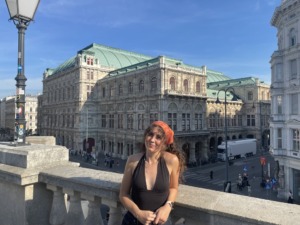
Vienna is a beautiful city. Somehow, it felt less overwhelming than any of the other European capitals. Everything seems to have its place and there is a quiet sense of calm that accompanies you as you walk its streets. I always felt at peace there.
One unexpected encounter was with a wonderful man and host named Ivo. Through a series of unforeseen circumstances, we ended up staying in his beautiful family home. From the moment we met him, it was clear that he was someone who lived with remarkable intentionality. He was open, deeply thoughtful and not afraid to be vulnerable. Our first dinner reflected this. Although we barely knew one another, we found ourselves sharing experiences that revealed a common understanding of a particular kind of pain. Despite our different backgrounds and life stories, there was an immediate sense of being understood and seen without needing to explain much.
I walked away thinking again about what I can learn about music through this interaction. As performers, we often stand before audiences made up almost entirely of strangers. We may never know their stories, their joys or the burdens they carry. Yet somehow, through music, we can connect with them on a deeply human level. Sometimes we can even sit with someone in their sorrow, offer comfort or help them feel understood without ever exchanging a single word.
Perhaps that is one of music’s greatest gifts. It reminds us that, despite our different stories, we share something profoundly human. And sometimes, that quiet understanding is enough.
That brings me back to a quote shared by Filippo in London after his very captivating and moving Wigmore Hall recital: “There is, in every musician, a child that once fell in love with music, and for them that became the reason to live. That love is pure, idealistic, and jovial. As they emerge from their years as students and face the uncertainties of professional careers, I wish for every young musician to protect and nurture that love at all costs. Too often the practicalities, the compromises, or even our own ambitions lead us to forget and damage, sometimes irreparably, that inner child. No career is worth that loss … and the only musician the world will have no place for ultimately, is the musician who does not love music.”
Over this time, I was brought back to the young seven-year-old who once fell in love with music. I was reminded of what it meant to me back then… a safe space where I was allowed to be myself and express myself freely in surroundings that were seemingly scary and chaotic. It was where I went when I didn’t know how to process something or put it into words. It was a place of comfort. It was something that I knew was mine and couldn’t be taken away from me… and that I loved dearly.
Ivo was only one of dozens of significant people who contributed to making such an incredible opportunity possible for us. Everywhere we went, we were met with extraordinary kindness and generosity. Time and again, people opened their homes, shared meals with us, gave freely of their wisdom and encouraged us with genuine care.
I hope that one day I can extend even half of that kindness and generosity to the musicians and people whose paths cross mine.
REFLECTIONS
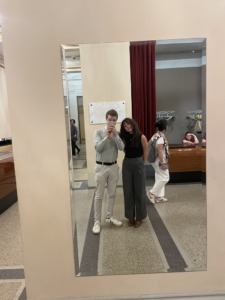
Having so many lessons in all these cities was both inspiring and overwhelming. There was so much to absorb and even more still to develop. One teacher reminded me of something I hope I never forget: our greatest gift is that we have time. Growth cannot be rushed. Real change happens patiently, almost imperceptibly, through hundreds of small steps. Often, by the time we notice we’ve changed, the transformation has already been quietly taking place.
Before Encores from 7 Cities and Sonata for 7 Cities, I believed that if I simply worked harder, practised more and somehow made it to Europe, everything else would fall into place. I now realise that becoming a musician is about so much more than practising or working hard. It is shaped by how we experience our daily lives, our “menswees,” as we would say in Afrikaans. Inspiration is found not only in the practice room, but in art galleries, museums, concert halls, conversations, friendships and the people we meet.
During these three months I probably attended more live concerts than I had in my entire life. Growing up in a small town in the Free State, where the classical music scene is almost non-existent, attending a concert always felt like an incredible privilege. I only heard my first live orchestra as a teenager and encountered chamber music for the first time in my second year at university. For years, I thought those experiences had placed me at a disadvantage. I often wondered whether things would have been different if I had simply been exposed to more, earlier.
Now, I see it differently. Rather than feeling behind, I feel incredibly fortunate to have experienced continual discovery. Moving to Cape Town opened an entirely new musical world to me, and Europe expanded that world even further.
I think many young musicians believe that if only they could get to Europe, everything would fall into place. That once we reach the places where the grass is greener and circumstances are ‘perfect’ we will finally become the musicians we dream of being.
This trip taught me that the answer is both ‘yes’ and ‘no’. Yes, Europe has an extraordinary musical heritage, and I learnt more than I could ever have imagined. But what ultimately transformed me was not simply changing my location. It was changing the way I related to music, to other people and to myself. Our relationship with music can be nurtured wherever we are.
My encouragement to every young musician is this: continue to dream. Work hard. Apply for the opportunities. Go abroad if you can. Learn from the very best, but don’t wait until you get somewhere else to begin becoming the musician you hope to be. Be fully present where you are. Keep learning. Keep listening. Keep discovering the world around you and, just as importantly, the person within you. If you remain curious, authentic and deeply connected to what aligns with you and your relationship to music, I believe the rest has a way of unfolding in its own time.
The French have a beautiful expression: joie de vivre, the joy of living. I think that is what I found along the way. A renewed joy not only in music, but in simply being alive.
Looking back, I left for Europe hoping to deepen my relationship with music. I returned having discovered a deeper relationship with life itself. For that, I will be forever grateful.
Read Isaac van der Merwe’s Encores from 7 Cities blog We Must Never Stop Building Cathedrals here
Photographs by Isaac van der Merwe