
Lucy tells of her longtime fascination with the works of György Kurtág and the intense creative process of collaboration with double bass player, William Langlie-Miletich and composer and animator, Lembit Beecher to bring to life the composer’s Fragments from the Scrapbooks of Georg Christoph Lichtenberg in a specially curated programme that debuts in Seattle on 6 November 2026.
Strangely enough, the score for Kurtág’s Einige Sätze aus den Sudelbüchern Georg Christoph Lichtenbergs, Op 37a, first came into my life as a Christmas gift. Intrigued by the texts but intimidated by the demands of range (a work for soprano with low F’s?), it traveled with me through various moves over more than a decade. My fingers would stumble over the spine on the bookshelf, but never lingered long. It was not until I was assigned the work at the Marlboro Music Festival in 2021, a request from double bassist Will Langlie Miletich, that I pulled the slim volume from the shelf and began to delve into its 22 miniature worlds in earnest. By that point, I had also made forays into Kurtág’s other works, including his monumental Kafka-Fragmente (and even his body of keyboard works called Játékok, a movement from which I performed with my newly-minted husband as a part of our wedding ceremony).
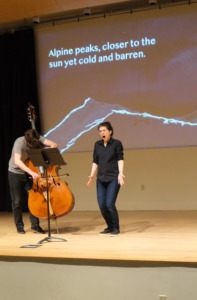
Encountering any score is, to some degree, an exercise in parsing centuries of allusion, assumption, and tradition. How else to explain the alchemy that transforms lines and circles into music? With Kurtág it is even more so: he of course makes some use of standard music notation (clefs, time signatures, accidentals), but he also draws on a combination of more archaic notational standards alongside a corpus of symbols – commas of various sizes, fermatas of various orientations and shapes, squiggles and other expressive lines – that occasionally appear in indexes, but often enough without complete explanation. Beyond this, Kurtág is well known for the wealth of literary, musical, historical, and personal allusions that infuse his work, from quotations to dedications to the evocation of different instrumental sounds altogether. I have also found, thanks to my experience with the scores themselves and the privilege of working with him this past spring, that every detail emerges in some way from the text, from the sounds of the language itself, or even its larger subtext. Performing his music, then, often requires an archeological level of engagement with the score and its many influences. In our long practice sessions, Will and I found ourselves looking up other Kurtág scores, listening to traditional Hungarian folk music, asking questions of Kurtág experts, discovering myriad musical allusions, and talking about philosophy and literature, the natural sciences and history, global exploration and globalization, and above all, irony.
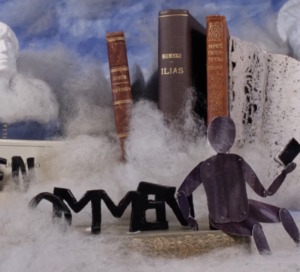
For all the richness of these miniatures, Einige Sätze aus den Sudelbüchern Georg Christoph Lichtenbergs, Op 37a, has a lightness and humor to it which we also wanted to convey. As we spent more time with the work, we kept talking about the audience we wanted to reach. For a primarily English-speaking audience in the United States, how could we best convey the kaleidoscopic worlds and shifting humor (even absurdity) of this piece? Would visual imagery help? In particular, we were hoping to evoke the tactility of Lichtenberg’s “scrap books,” married to the slight unreality of his prescient observations. Once we started talking about animation, we couldn’t get the idea out of our heads. Thanks to grant seed money from the Curtis Institute, and a transformational award from BBT, we were able to commission composer and stop-motion animator Lembit Beecher to create a visual accompaniment for the work. The three of us strove to find a balance between the direct communication made possible by visual imagery while keeping the music and text in the foreground. A residency and workshop presentation of the piece at Marlboro gave us the opportunity to refine our ideas, and we are eagerly anticipating the premiere of this version of the work at the Seattle Symphony’s Octave 9: Raisbeck Hall in November.
View examples of Lambit Beecher’s animations for Lucy’s Kurtág project here and here
Photographs by Anne Marie Strader and Lambit Beecher.